BİZİ ARAYIN
+90 232 374 51 65
Roof panels go beyond being merely a cladding element in today’s modern construction industry and stand out as advanced building solutions that simultaneously address many critical needs such as energy efficiency, structural strength, fire safety, and environmental sustainability. Especially in industrial buildings, warehouses, logistics centers, cold storage facilities, and large-span structures, roof panels are widely preferred thanks to their fast installation, long service life, and low maintenance costs.
Basically, roof panels are composite building elements consisting of two thin yet high-strength outer facings and a low-density insulation core positioned between them. While pre-painted galvanized steel or aluminum is commonly used for the outer surfaces, the core material directly determines the panel’s thermal, acoustic, and fire performance. Designed based on the I-beam principle, this system allows the outer facings to resist bending moments, while the core material carries shear stresses. As a result, roof panels offer an excellent strength-to-weight ratio by providing high load-bearing capacity despite their lightweight structure.
The most critical factor determining the performance of a roof panel is its insulation core. Polyurethane (PUR) and Polyisocyanurate (PIR) core roof panels minimize heat transfer thanks to their closed-cell structure. With low thermal conductivity values ranging between 0.021–0.028 W/m·K, they significantly contribute to energy savings in buildings. PIR core panels, instead of melting and dripping during a fire, form a carbonized layer that limits flame penetration into the core of the panel. This characteristic makes PIR panels stand out in many projects in terms of fire safety.
Rock wool core roof panels, on the other hand, are classified as Euroclass A1 non-combustible thanks to their inorganic fibrous structure. These panels can provide fire resistance for up to 120 minutes and are therefore preferred in high-risk industrial facilities and buildings with strict fire regulations. In addition, rock wool offers a significant advantage in acoustic insulation by absorbing sound waves through its open-fiber structure. EPS (Expanded Polystyrene) core roof panels, which represent an economical and environmentally friendly alternative, stand out in sustainable projects due to their lightweight nature, resistance to water, and 100% recyclability.
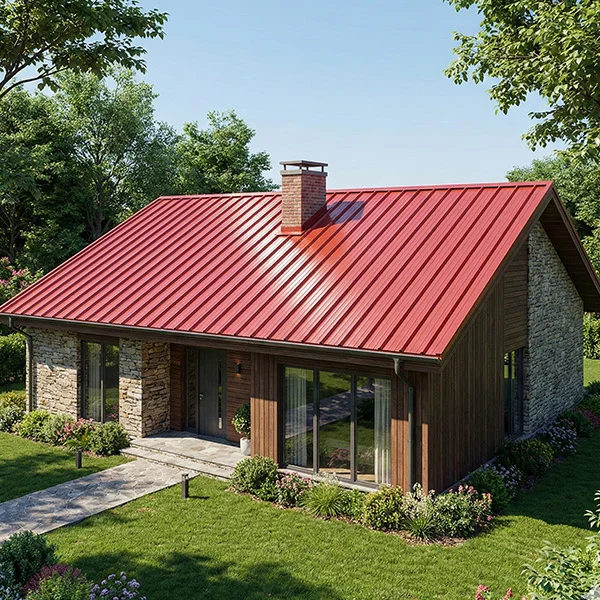
In roof applications, installation quality is just as important as panel selection in determining overall system performance. Especially hidden screw roof panels protect fixing points from external factors and minimize the risk of water leakage in the long term. These systems also provide a suitable infrastructure for the installation of solar energy panels. Correct determination of roof slope is critical for the controlled drainage of rain and snowwater. In practice, the ideal roof slope is generally planned between 7% and 10%.
Lap joint profiles, sealing tapes, and correct screw placement used in watertightness details prevent condensation, corrosion, and heat loss. These details extend the service life of the roof panel system while significantly reducing maintenance costs.
From a sustainability perspective, a large portion of the environmental impact of sandwich and roof panels occurs during the raw material production phase. Studies show that this impact accounts for approximately 48% to 84% of the total life cycle impact. At this point, the use of recycled EPS contributes significantly to the circular economy by reducing environmental impacts by an average of 21% compared to virgin raw materials.
Life Cycle Assessment (LCA) results demonstrate that selecting the right roof panel and insulation core can significantly reduce the carbon footprint of buildings. Energy-efficient roof systems support both environmental and economic sustainability throughout the building’s lifespan.
Roof panels, which have a wide range of applications from industrial facilities to cold storage warehouses, protect buildings against external factors throughout their long service lives, which can range from 30 to 90 years. In the future, these systems are expected to evolve into smart building envelopes that incorporate sensors, monitor structural health, and actively generate energy. Such developments will transform roof panels into not only a building component but also an active energy and data element.
In conclusion, roof panels are among the indispensable solutions of modern buildings, combining performance, safety, and sustainability within a single system.